





3D printing, also known as additive manufacturing, has revolutionized the way products are designed, prototyped, and manufactured. By building objects layer by layer from digital models, it enables faster production, design flexibility, and cost efficiency compared to traditional manufacturing methods.
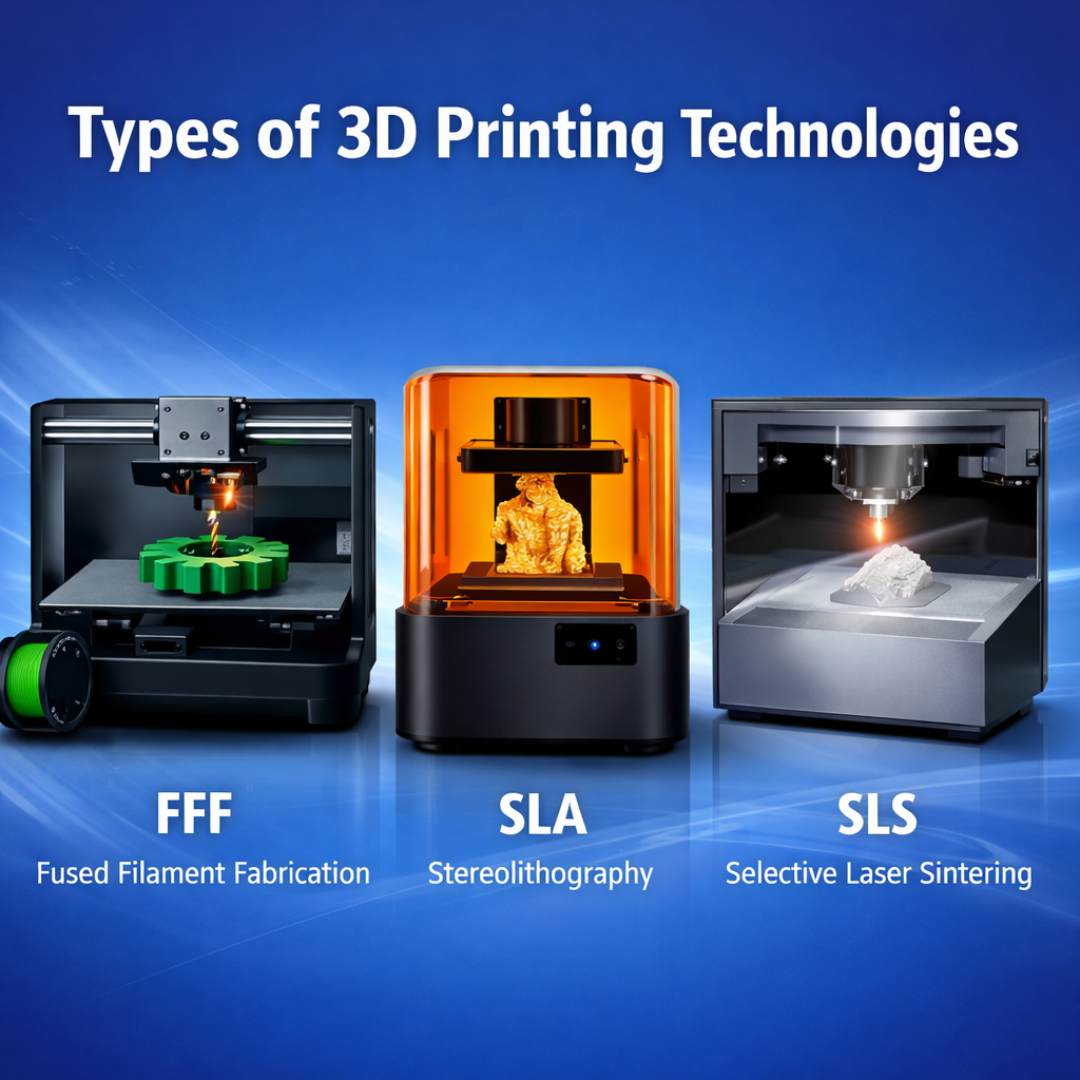
However, 3D printing is not a single technology. There are multiple techniques, each suited for different applications, materials, and levels of precision. Among these, FFF (Fused Filament Fabrication), SLA (Stereolithography), and SLS (Selective Laser Sintering) are the most widely used technologies.
This article provides a detailed explanation of these three major 3D printing technologies, their working principles, advantages, limitations, and use cases.
What Are 3D Printing Technologies?
3D printing technologies refer to the different methods used to create physical objects from digital designs. Each technology differs in terms of:
Printing process
Material used
Accuracy and resolution
Cost and speed
End-use application
Understanding these differences is essential for selecting the right method for your project.
1. FFF (Fused Filament Fabrication)
Overview
FFF is one of the most common and accessible 3D printing technologies. It works by melting a thermoplastic filament and depositing it layer by layer to form an object.
How FFF Works
A filament (such as PLA, ABS, or PETG) is fed into a heated nozzle
The nozzle melts the material
The printer deposits the material layer by layer
Each layer solidifies to form the final object
Advantages of FFF
Cost-effective and widely available
Suitable for beginners and rapid prototyping
Supports a wide range of materials
Ideal for functional parts and basic models
Limitations of FFF
Visible layer lines
Lower resolution compared to other technologies
Limited surface smoothness
Applications of FFF
Product prototyping
Educational models
Functional components
Custom parts
Why Choose FFF?
FFF is the best choice when affordability and speed are priorities. Service providers like Layer by Layer utilize optimized FFF processes to deliver high-quality prints at competitive pricing, making it ideal for startups and individuals.
2. SLA (Stereolithography)
Overview
SLA is a high-resolution 3D printing technology that uses a laser to cure liquid resin into solid objects. It is known for producing extremely detailed and smooth prints.
How SLA Works
A vat is filled with liquid photopolymer resin
A laser selectively cures the resin layer by layer
The object is built from bottom to top
Post-processing (washing and curing) is required
Advantages of SLA
High precision and fine details
Smooth surface finish
Ideal for intricate designs
Limitations of SLA
Higher cost compared to FFF
Requires post-processing
Resin materials can be less durable
Applications of SLA
Dental and medical models
Jewelry design
Miniatures and prototypes
High-detail components
Why Choose SLA?
SLA is suitable for projects requiring precision and aesthetic quality. If your design demands fine detailing, SLA is a preferred option offered by professional services.
3. SLS (Selective Laser Sintering)
Overview
SLS is an advanced 3D printing technology that uses a laser to fuse powdered materials into solid structures. It is widely used in industrial applications.
How SLS Works
A thin layer of powder (usually nylon) is spread across the build platform
A laser selectively sinters the powder
The platform lowers, and a new layer of powder is applied
The process repeats until the object is complete
Advantages of SLS
No need for support structures
Strong and durable parts
Suitable for complex geometries
High production efficiency
Limitations of SLS
Higher cost
Rough surface finish compared to SLA
Requires industrial-grade equipment
Applications of SLS
Functional prototypes
End-use parts
Aerospace and automotive components
Complex mechanical designs
Why Choose SLS?
SLS is ideal for high-performance and industrial-grade applications, especially when strength and durability are critical.
Comparison of FFF vs SLA vs SLS
| Feature | FFF | SLA | SLS |
|---|---|---|---|
| Cost | Low | Medium | High |
| Surface Finish | Moderate | Smooth | Slightly Rough |
| Strength | Moderate | Low-Medium | High |
| Detail | Moderate | High | High |
| Best For | Prototypes | Detailed Models | Functional Parts |
How to Choose the Right 3D Printing Technology
Selecting the right technology depends on your specific requirements:
Choose FFF for affordability and basic prototypes
Choose SLA for high detail and smooth finish
Choose SLS for durability and complex functional parts
A reliable service provider can guide you in selecting the most suitable option based on your project goals.
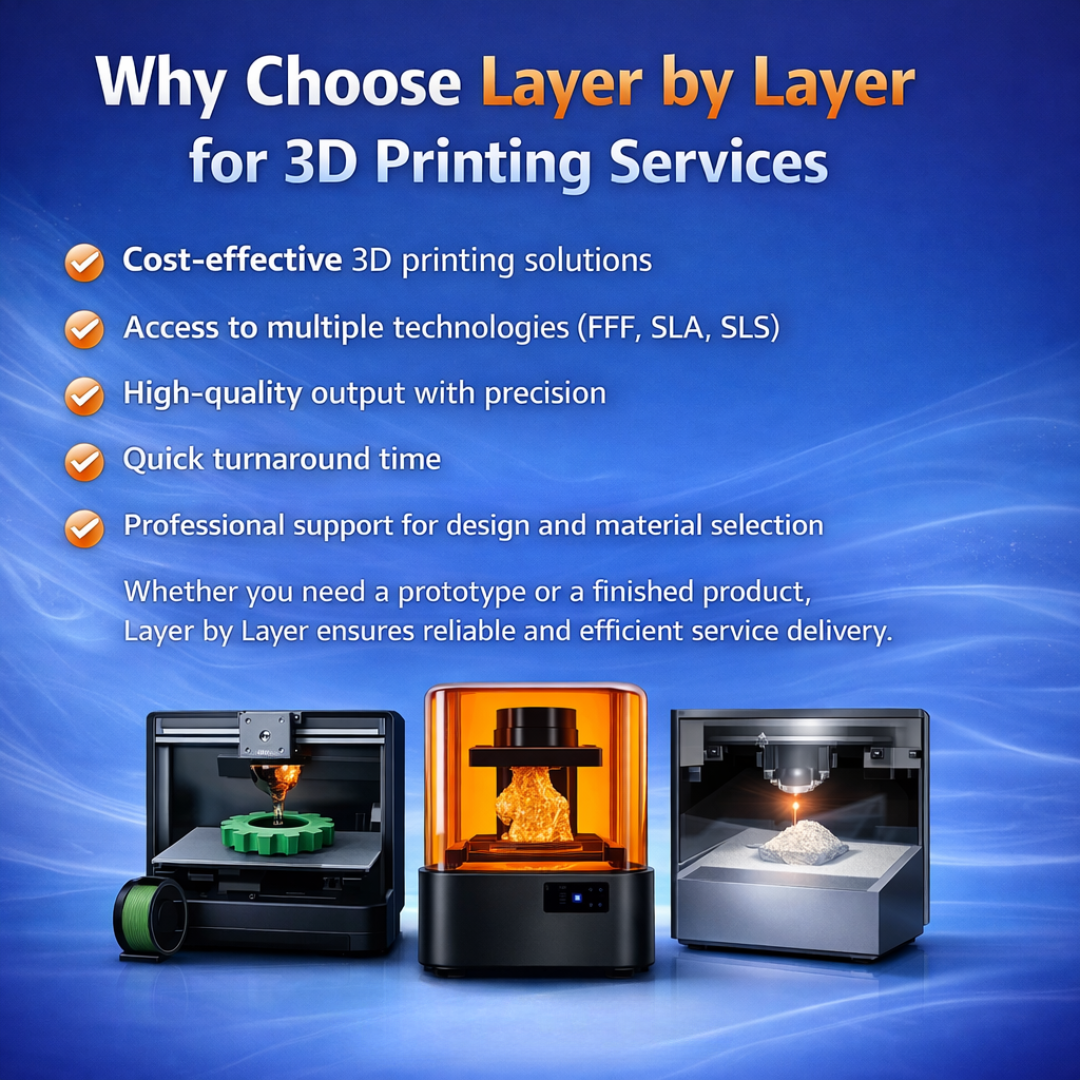
Why Choose Layer by Layer for 3D Printing Services
When it comes to selecting a 3D printing partner, affordability and quality are key considerations.
Layer by Layer offers:
Cost-effective 3D printing solutions
Access to multiple technologies (FFF, SLA, SLS)
High-quality output with precision
Quick turnaround time
Professional support for design and material selection
Whether you need a prototype or a finished product, Layer by Layer ensures reliable and efficient service delivery.
Conclusion
Understanding the different types of 3D printing technologies is essential for making informed decisions. FFF, SLA, and SLS each offer unique advantages, making them suitable for different applications.
As 3D printing continues to evolve, choosing the right technology and the right service provider can significantly impact the success of your project.
With affordable pricing and a commitment to quality, Layer by Layer provides a dependable solution for all your 3D printing needs.
Contact Layer by Layer
Looking for affordable and reliable 3D printing services?
Layer by Layer is here to help you bring your ideas to life with precision and efficiency.
Phone/WhatsApp: +91 7000849378
Service: Online 3D Printing (Upload & Print)
Get in touch today to discuss your project and get a customized quote.
FAQs
1. What are the main types of 3D printing technologies?
The most common types include FFF, SLA, and SLS, each with different materials and applications.
2. Which 3D printing technology is the most affordable?
FFF is generally the most cost-effective option for basic prototypes and models.
3. Which technology provides the best surface finish?
SLA offers the smoothest surface finish and highest detail.
4. Which 3D printing method is the strongest?
SLS produces the strongest and most durable parts.
5. Can I use different technologies for the same project?
Yes, depending on different components and requirements, multiple technologies can be used.
6. How do I choose the right 3D printing service?
Consider factors like pricing, quality, available technologies, and customer support.