





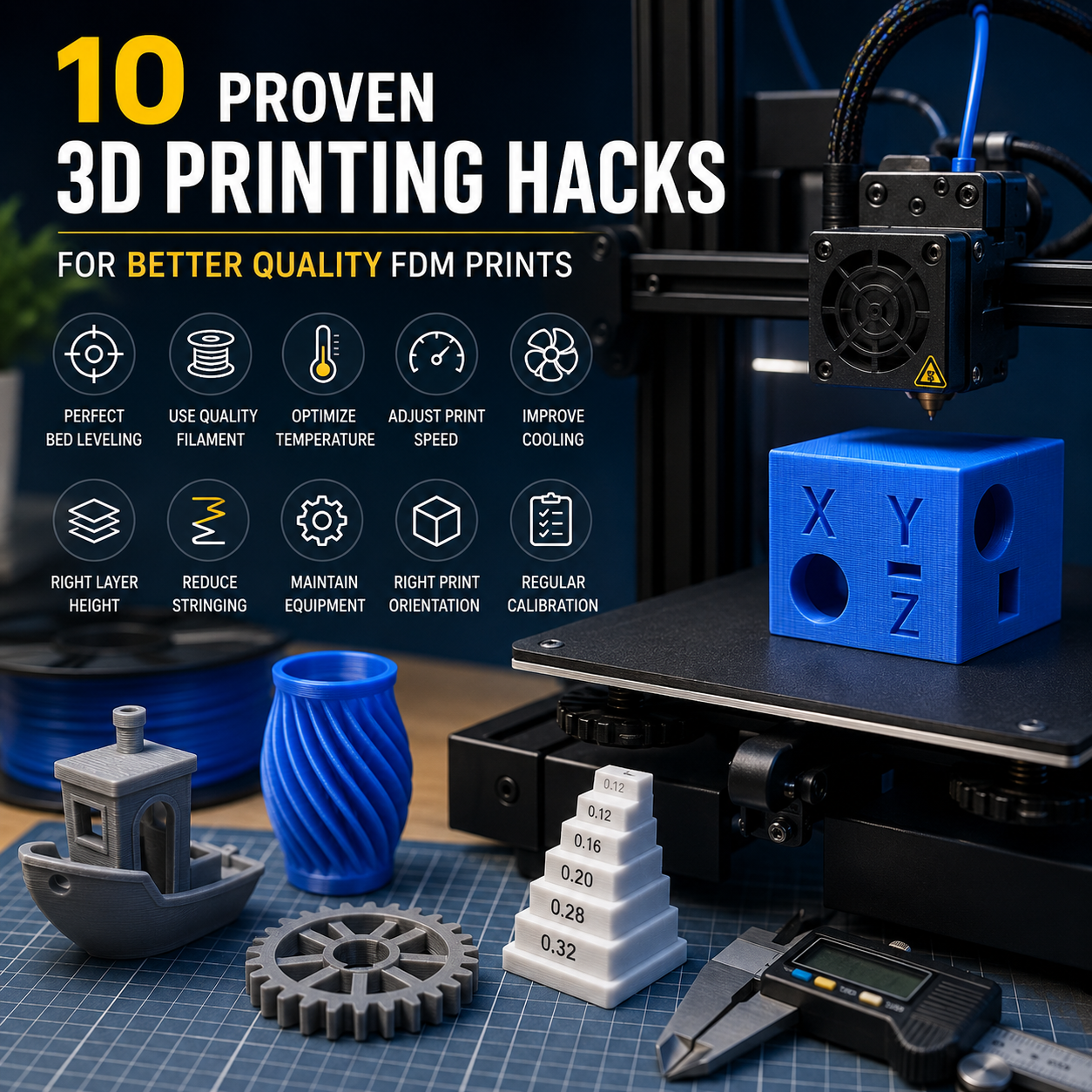
10 Proven 3D Printing Hacks for Better Quality FDM Prints – FDM (Fused Deposition Modeling) 3D printing has become one of the most widely used additive manufacturing technologies for prototyping, product development, and small-batch production. However, achieving high-quality prints consistently can be challenging, especially for beginners and even experienced users who want professional-level results.
Issues like poor layer adhesion, rough surfaces, stringing, warping, and dimensional inaccuracies can affect the final print quality. The good news is that most of these problems can be solved by applying a few simple but powerful techniques.
In this article, we will explore 10 practical 3D printing hacks that can significantly improve the quality of your FDM prints.
1. Proper Bed Leveling is the Foundation of Good Prints
One of the most important factors in FDM printing is bed leveling. If the nozzle is too far from the bed, the filament won’t stick properly. If it’s too close, the filament will get squished and may clog the nozzle.
A well-leveled bed ensures:
- Better first layer adhesion
- Reduced warping
- Higher dimensional accuracy
Many professional users recommend performing a bed leveling check before starting important prints.
2. Use High-Quality Filament
Filament quality plays a major role in the final print outcome. Cheap or poorly manufactured filament can have inconsistent diameter, moisture issues, and impurities.
Using high-quality filament ensures:
- Consistent extrusion
- Better layer bonding
- Smooth surface finish
Store your filament in dry containers or vacuum bags to prevent moisture absorption.
3. Optimize Printing Temperature
Every filament material has an optimal temperature range. Printing too hot can cause stringing and blobs, while printing too cold can lead to weak layer adhesion.
Typical temperature ranges include:
PLA: 190–220°C
ABS: 220–250°C
PETG: 220–245°C
Running a temperature tower test can help identify the ideal temperature for your filament.
4. Adjust Print Speed for Better Surface Quality
Printing too fast can cause several problems, including poor layer adhesion and rough surfaces.
For high-quality prints:
- Reduce speed for detailed parts
- Use slower speeds for outer walls
- Keep consistent extrusion
Professional prints usually run between 40–60 mm/s for optimal results.
5. Improve Cooling Settings
Cooling fans play a crucial role in achieving sharp details and smooth overhangs.
Proper cooling helps with:
- Overhang quality
- Bridge performance
- Surface finish
PLA typically requires strong cooling, while ABS may require reduced cooling to prevent warping.
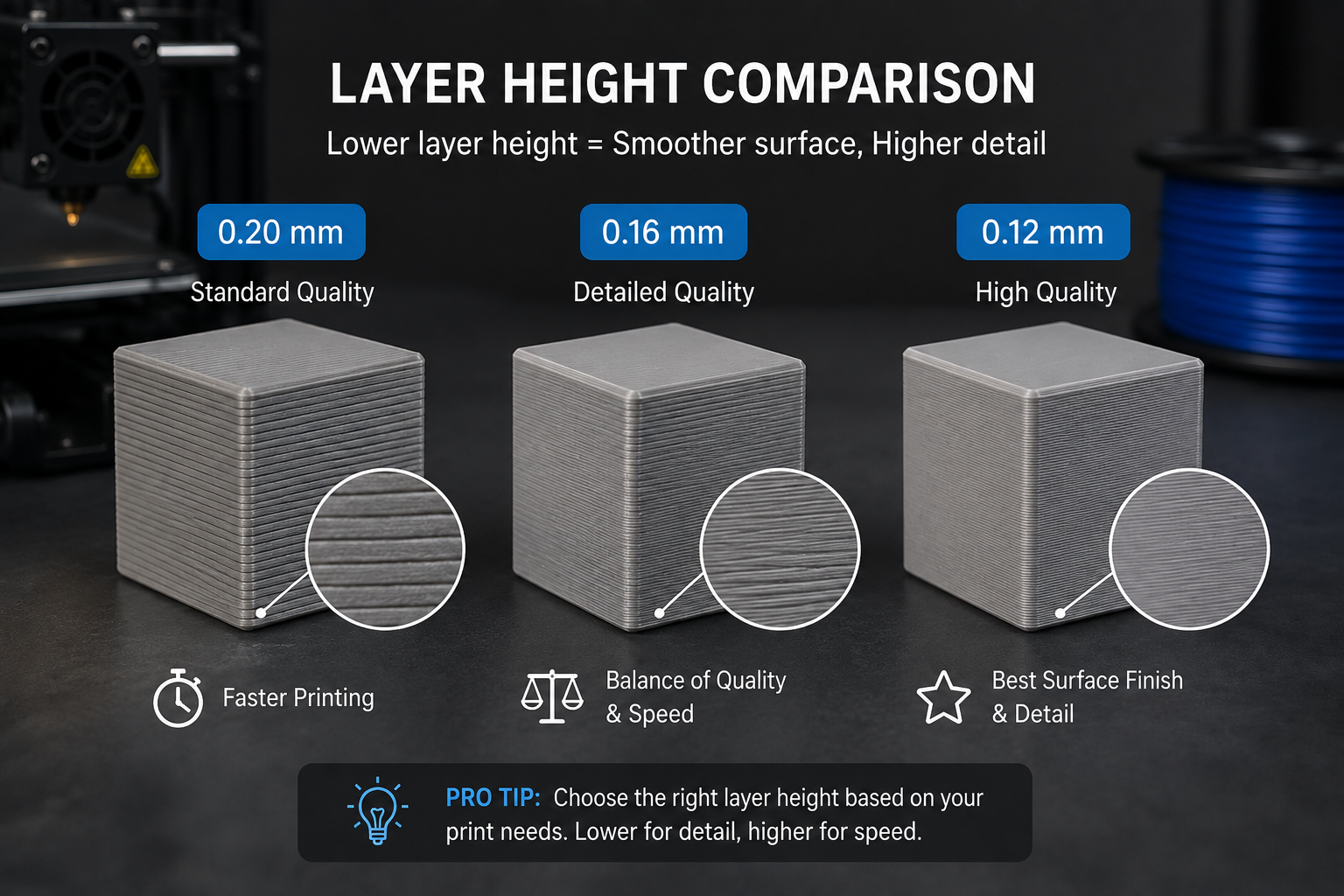
6. Use the Right Layer Height
Layer height directly affects surface finish and print detail.
Common layer heights include:
- 0.2 mm for standard prints
- 0.16 mm for detailed prints
- 0.12 mm or lower for high-quality surface finish
Lower layer heights increase detail but also increase printing time.
7. Reduce Stringing with Retraction Settings
Stringing happens when molten filament leaks from the nozzle during travel moves.
To reduce stringing:
- Increase retraction distance
- Increase retraction speed
- Lower printing temperature slightly
Fine-tuning retraction settings can dramatically improve print cleanliness.
8. Maintain Your Nozzle and Extruder
A worn-out or partially clogged nozzle can affect extrusion quality.
Regular maintenance includes:
- Cleaning the nozzle
- Replacing worn nozzles
- Checking extruder gears for debris
A clean extrusion system ensures consistent filament flow.
9. Use Proper Print Orientation
Print orientation affects both surface quality and part strength.
For better results:
- Orient visible surfaces upward
- Minimize supports when possible
- Align layers with stress direction for stronger parts
Good orientation reduces post-processing work.
10. Calibrate Your Printer Regularly
Printer calibration is essential for achieving consistent results.
Important calibrations include:
- E-step calibration
- Flow rate tuning
- XYZ axis calibration
A well-calibrated printer produces parts with better accuracy and repeatability.
Why Professional 3D Printing Services Deliver Better Results
While home printers are great for experimentation, professional 3D printing services offer several advantages:
- Industrial-grade machines
- Expert print optimization
- Advanced materials
- Post-processing capabilities
This results in higher precision, stronger parts, and better surface finish, making professional services ideal for product development and prototyping.
Need Professional 3D Printing or CAD Design Services?
If you’re looking for high-quality FDM/FFF 3D printing services, rapid prototyping, or CAD product design, feel free to get in touch.
Dronesh Rane
Mechanical Engineer | CAD Designer | 3D Printing Specialist
📧 Email: contact.layerbylayer@gmail.com
📞 Phone: +91-7000849378
🌐 Website: www.layerbylayer.in
Services offered:
- 3D Printing (FDM / FFF)
- Rapid Prototyping
- Product Design
- CAD Modeling
- Custom 3D Printed Parts
Let’s turn your ideas into real products.
Frequently Asked Questions (FAQs)
1. How can I improve the surface finish of my FDM prints?
Improving surface finish can be achieved by lowering layer height, reducing print speed, optimizing temperature settings, and using high-quality filament.
2. What causes warping in 3D printing?
Warping usually occurs due to uneven cooling or poor bed adhesion. Using a heated bed, proper bed leveling, and adhesive surfaces can reduce warping.
3. Why do my 3D prints have stringing?
Stringing happens when melted filament leaks during travel moves. Adjusting retraction settings and lowering the printing temperature can reduce stringing.
4. What is the best layer height for high-quality prints?
For high-quality prints, a layer height between 0.12 mm and 0.16 mm is recommended.
5. Why is my first layer not sticking to the bed?
Poor bed leveling, incorrect nozzle distance, or a dirty build plate can prevent the first layer from sticking properly.
6. Which filament material gives the best print quality?
PLA usually provides the best surface finish and is easiest to print, making it ideal for beginners and detailed models.
7. Is FDM printing suitable for functional parts?
Yes. Materials like ABS, PETG, and Nylon can produce strong and durable functional parts suitable for many engineering applications.
8. Can professional 3D printing services improve print quality?
Yes. Professional services use optimized machines, advanced materials, and expert tuning to produce higher-quality prints compared to standard home printers.